Wednesday, October 16, 2013

The Country of Normal- 31 for 21

I posted this last year, with permission from Paul and Susan Carson.  

We had the pleasure of meeting the Carsons shortly after Cora arrived in our lives.  We are very lucky to have them as friends and want to share some of Paul's wisdom with you here.  You can read more about the amazing Carson family and their little boy Anthony at Susan's blog, Keeping Up With The Carsons.

 “The Country of Normal”
 (a fable by Anthony's Dad)

If you travel, there’s a country you may have visited called Normal. You may even live there. Normal has a bit of an overpopulation problem – it seems that everybody wants to live there. The folks who live in Normal tend to talk the same way, dress the same way and its citizens are encouraged to paint between the lines and do their best to fit in.

Every now and then, someone will be born in Normal who’s a little different.

For some reason, these different folks seemed to scare the inhabitants of Normal. If you were different, you would find that you’d been asked to leave the country and that your citizenship in Normal had been revoked.

The Governor of Normal wanted everyone to feel safe. “When things are different, folks aren’t sure what to expect and that scares ‘em!” he explained, “Birds of a feather!”

First, the Governor began to worry about people who’d been born someplace else: “They’re originally from a different country – they talk funny and believe in a different book about a different God! That scares folks and makes ‘em doubt things! If other folks believe something different, that could mean that there’s a chance that what I believe could be wrong.”

Then, the Governor decided everyone whose skin happened to be a different color should be asked to leave – because that probably was a good sign they were originally from someplace else anyway.

The Governor felt that things still weren’t Normal enough. So everyone who happened to have been born with an extra chromosome was told they had to go someplace else. “We all like to do things at the same fast speed here in Normal, and, well, you just aren’t fast enough…”

 Then it was time to deal with people whose intimate relationships were different – “Having two mommies or two daddies isn’t the Normal way,” said the Governor. “Those kinds of relationships threaten our Normal relationships.” The Governor couldn’t really explain why that was, but everyone agreed it was probably for the best.

He was making progress, but things still weren’t Normal enough. There were all these Heavy-set people who just didn’t fit in. They would have to go – they were eating all the food. Then there were the really old people – and the young people with the uncertain new ideas. It seemed the more the Governor looked for people who didn’t belong, the more of them he found.

One day the Governor overslept and when he woke up he realized he was out of coffee. So he decided to walk to the store to get some – but the store was closed. He remembered it had been run by someone who had been born someplace else. He continued down the street and realized that all the other stores were closed as well. They’d been owned by fat people or gay people or slower people – they’d all moved away. The Governor had wandered all the way to the farthest fence near the border, and he realized he was all alone – he was the last one left. He dropped to his knees and without really knowing why, he began to cry. “What have I done? I never thought I’d be all alone – this isn’t what I wanted!” he cried.
Suddenly a voice called out to him from beyond the fence, over on the other side. It was a little girl. Her skin was darker than his and he could tell by looking at her that she’d been born with an extra chromosome – that she was different. “Don’t cry, mister. You don’t have to be alone – we have room for you over here."

She opened up the gate and she took his hand. Here were all the people who’d left – all of them – and they were living together. Everyone seemed happy – and there were so many differences, all mixed together, it was impossible to tell who was who. Funny how it didn’t seem to matter anymore.

“You’re so kind to take me in,” he said. “What is this place?”

“We call it the Country without Fear,” she replied. “That’s the only thing that can’t live here.”

You can read the original post here at  Keeping Up With The Carsons- The Country of Normal and become a follower of Susan's blog.

For more from Paul, check out his contribution to the December 2011 NWDSA newsletter, "You're a hero to somebody- clown shoes optional."  (Page 5)

Tuesday, October 15, 2013

Making Waves- 31 for 21

There is a lot of talk about Down Syndrome Awareness Month spiraling around out there.  I haven't specifically talked about my decision to blog in the 31 for 21 challenge this month.

Part of it is because it is a personal challenge to post something every day.  Part of it is because I feel like I needed an excuse to start writing again, and I know that when I start to write more often it becomes easier to write.  I find that I have things to say, and even when I don't, I enjoy the process and I enjoy sharing about Cora.

For me, promoting "Down syndrome awareness" started as something pretty simple. I started writing as a way to communicate with friends and family, but also to express some of the thoughts, feelings, joys and worries I was discovering as I went through the life-changing process of becoming a parent while beginning to intimately consider how disability is perceived and treated in our culture. 

Knowing how much the idea of Down syndrome scared me when Cora was born, I wanted the people I cared about to have the chance to see Cora like I saw her; to see her as a person.  I hoped that by sharing, I could help gradually dissolve some of that fear, so others could be more accepting of her.  Perhaps my initial motivation was selfish, as my goal was really to help create acceptance for Cora as an individual, not necessarily for the disability community as a whole.  The feedback was positive, so I felt like things were heading in the right direction.

Since then I've had a lot of opportunities to consider just how vast that endeavor toward awareness and acceptance in our culture really is.  I have heard enough perspectives to break my heart and make me feel like I'm up against the impossible, and then to give me hope and inspiration, only to make my head spin.

There are so many BIG discussions about awareness and acceptance for those with differences.  We need to keep talking about these things:  About being seen and appreciated as different and unique individuals.  About how knowing one person with a disability does not mean you know all people with that disability.   About how we want society to see our children for who they are, rather than judging them by the way they look or act, or by how they learn or speak.  About listening to those with disabilities and remembering that it is about them first.  About recognizing that what makes people valuable is not only what they produce.  About what kind of world we want our children to live in and how we can help get there.

We live in a time when there are so many voices weighing in, so many people wanting to promote awareness and acceptance, and often in very different ways. 

And I want to be a part of these conversations.  I want to keep listening and keep thinking.  I want to hear the voices of the parents and the self-advocates and the voices of those that aren't speaking up for themselves.  There is room for so many voices and so many points of view.  Sometimes I don't know exactly where I fit into it all, or exactly what I want my voice to say.

But in the meantime I am learning.  I am finding a voice, little by little, and sharing when I feel brave or inspired.  I may not be reaching an enormous audience, but those that I have reached have shown me the waves that even my small ripples can make. And the people that are teaching me are helping make more waves.  And I just can't wait to see how Cora herself will continue to impact the world.

Our individual voices and stories, as small as they may be, can still make an impact.  Even if we're not pounding the pavement or writing laws, even if we help only one person at a time, or work toward one goal at a time, we can be making small changes.  And lots of small changes can add up to some BIG things.  That, at least, is my hope.

Monday, October 14, 2013

The Process- 31 for 21

I often hear parents mention how much work and practice goes into building meaningful communication with their children with Down syndrome.  I've heard again and again that it often requires significant purposeful practice to get to the point of regularly and effectively communicating desires, needs, or feelings, often even after a child has the building blocks to do so.

And it certainly is so with Cora.  But sometimes I wonder why it is such a process.

Take this morning for example.  Cora definitely has the language skills to tell me what she wants to eat.  She had finished most of her breakfast but still seemed hungry, so I asked her what she wanted to eat.

First she signed "fruit."  So I said, "Ok, fruit" and started to get her favorite fruit sauce.  She immediately starts shaking her head, saying "Uh uh! Uh uh! Uh uh!" and signing "no fruit."  

Then she says "pbpbpbpbpbmmmoooodeeeeee," which is her word for smoothie. When I reach for her smoothie she again tells me no.

Finally she signs "yogurt" so I ask her if she really wants yogurt.  She gives me her "yes"face with an enormous grin and then signs "yes." Of course she immediately launches into a drawn-out, smiley "no", but it's the one that she uses when playing.  

So yes, she really wanted yogurt.

So if she has the tools to tell me, why is it such a process?  It's like this so often.  She either doesn't respond, repeats my questions back to me through sign, or she uses her signs and words, but runs through a long list of options before finally clueing me in, like today.  It doesn't feel like a game and I don't feel like she's just indecisive.  Maybe she is simply practicing.

I know that she understands the words.  I know that she can communicate what she wants.  But sometimes drawing it out of her is painfully slow.  Where is the disconnect?  How much of it is the innate contrary nature of a two-year-old, and how much of it is part of the mysterious effect of her extra chromosome?

Either way, it doesn't change the fact that it doesn't come easily.  I see that she is learning and making progress, but all this patience is tiring me out.

Sunday, October 13, 2013

Written on Your Face- 31 for 21

I wrote this last year during Down Syndrome Awareness Month.  It's worth sharing again.

My best friend worked at a day camp a few years ago.  Thinking back, I remember her telling me about a couple of her favorite kids.  After Cora was born she talked more about them:  about their wacky, silly senses of humor, their enthusiasm, and about how so much of them stuck with her over the years.

Oh yeah.  They had Down syndrome.

She told me that she had a conversation with one of the boys where he told her how it was hard to be judged by the way you look.

I know that is a concern that many parents like me share.  We worry that our children will be judged by the differences written on their faces before they have made an impression as individuals.

I'm sure it will happen a lot.  And as much as I hate thinking about it, the thought of Cora feeling that way about herself breaks my heart a little.

One could argue that having a disability that is recognized by physical characteristics alone could have some benefits.  Perhaps people will have more patience or understanding upon recognizing her difference.  Maybe they will postpone judging.

But some will definitely judge faster based on what they see.  Because the familiar characteristics of Down syndrome are visible, in a way like a brand.  With that brand comes a lot of expectations, most of them low.

What you can't see in someone's facial features, though, are their talents, their gifts, or the way they can shatter expectations. 

From where I stand now, which is admittedly pretty early on in my consideration of disability, the best way to gradually start to diminish the judgments has to be exposure.  It starts in our communities, in our baby groups, story times and social media.  And it's critical in our schools.

As incredible as we know inclusion is for our children with disabilities, it's also so important for the other children.  It's important for those small children to sit side-by-side with their peers with Down syndrome and autism and others who are differently-abled.  It's important for them to have the opportunities to know people like Cora and to start to remove that insipid fear of the unknown.

I wish I would have had the chance to grow up in a community and in schools like that.  I wish that it didn't take Cora's birth to make me realize that awareness, acceptance and support is so critical to all of us.  But I am here now.  And now I can do my little part to make sure that Cora is seen, that she is heard, that she is a part of her community.

I can't remove judgment from people's minds and hearts.  I can't erase the fact that Cora's diagnosis is written on her face.  But I can continue to advocate for her, to give her the best opportunities I can, and to help ensure that she is included; for the good of her and for the good of our society.

Saturday, October 12, 2013

More Flashbacks: Lost in The Baby Blues- 31 for 21

I needed a dose of my little 7-month old Cora this morning.

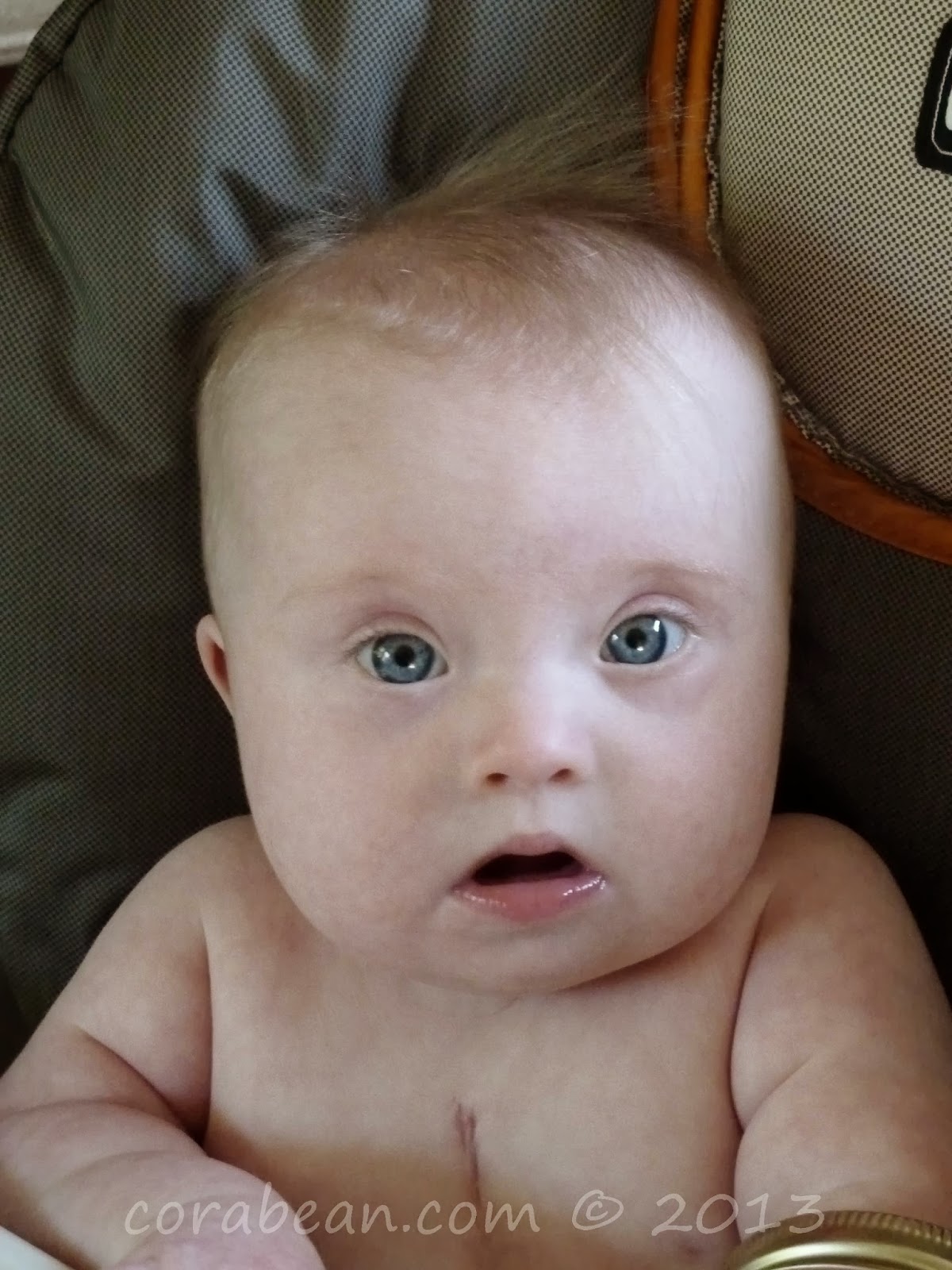
Look at this pretty little face with the fuzzy little shock of hair that grew only on the top of her head.   Her scar still looks pretty raw, but manages to show just how tough she is. 

I can still feel the soft squishy cheeks that begged for kisses.

Friday, October 11, 2013

What's on your Face? 31 for 21

Down syndrome awareness month has been keeping me thinking, but sometimes you just feel like lightening things up.  So today I offer a little glimpse of my recent entertainment, courtesy of the Beanie One.

I was sitting across from Cora the other night as she finished her dinner.  Nick had already cleared our empty bowls and put away the minestrone that his mother used to make.

Cora of course ate only bread and yogurt, since eating well-rounded meals has never been her forte.

At this point she was feeding herself the yogurt, and she looked a lot like this (swap a white beard for the brown one here).


Then she tired of feeding herself and handed me her spoon.  I fed her a few bites and then casually dotted some yogurt on my upper lip and looked at her.

She immediately started signing yogurt and pointing to my face.

"What?" I said.  "What do you see?"  She kept signing and pointing at me, expressing her disapproval.

I fed us each another bite, then applied another glob to my right cheek.  She looked at me completely shocked, obviously wondering how I could be so messy.

By my parents' account I was the messiest child around.  They tell of the shower curtain they put under my highchair that needed cleaning several times a day.  Even now I'm not the neatest person when it comes to food.  I wear an apron in the kitchen for a very good reason.  A visit with my best friend wouldn't be complete without her pointing out a spot of food on my face or clothing.  Somehow my usual dirty apron or speck of avocado on my chin doesn't phase Cora, but this certainly did.

Of course, the fact that she had yogurt streaked from her hair to her chest wasn't worth noticing.

My funny, observant little girl.  She certainly doesn't miss much.

Thursday, October 10, 2013

Beauty in the Eye of the Beholder- 31 for 21

My friend Michelle over at the Hailey Herald just published a lovely post highlighting the beauty of a number of kids with Ds.  It definitely displays a lot of smile-inducing cuteness.  And it got me thinking...

One of the initial worries that I've heard a ton of new parents admit is that their child won't be beautiful.  I know that it is one of the more superficial worries to have, but it's there nonetheless.

I have to admit that I had the same thought when Cora was born.  I remember when she was still in the hospital and I was sitting there with my mom, I asked out loud if she thought Cora would look like she had Down syndrome when she was older.  I still hadn't really accepted the idea of my daughter having Ds, and I just couldn't picture how this tiny little adorable baby (who actually DID look like she had Ds and I knew that even then) would still be beautiful as she got older if the features of Down syndrome were apparent.  When my mom answered that yes, she most likely WILL look like she has Down syndrome, I felt disappointed and discouraged.

A couple weeks later my sister Mira was visiting.  There is something about Mira and my mom, something that just allows me to bare my soul, even when my soul isn't very nice or very pretty.  So I made a confession to Mira that I hadn't told anyone else.  I told her that I liked it when I looked at Cora or saw a photo of Cora and didn't automatically see Down syndrome.  I told her that often when I looked at Cora and recognized Ds, I didn't like it; that it made me uncomfortable and worried.

Mira, ever honest, and usually with a refreshing perspective that doesn't always conform to the norm but that always speaks to the real heart of things, gave a little smile and said,

"Really?  I kind of love it when I can see it in her.  I think it is part of her beauty."

And you know what?  That moment started a shift in me.  All of a sudden I could see what Mira meant, and I could see that it was true.  That those angles that showed Cora's slanted eyes and the flat bridge of her nose, and even that mysterious indefinable quality that can't really be described by specific features but that just IS; seeing those qualities suddenly became less worrisome.  I started to see the beauty in them too.  And I started to be more comfortable with them.

Time has certainly continued to change how I see Cora.  While I used to sometimes worry about whether people out and about in the world could "tell," now I just assume that everyone can tell.  And I love it.  I am proud of it.  Heck, I admit it:  I am a bit vain about the fact that my daughter is pretty dang gorgeous.  I am sure that if she weren't objectively pretty I would be fine with that, and I'd probably still find her beautiful because I know and love her.  And love sure makes someone attractive.  But Cora is seriously beautiful.  And Down syndrome is a part of her beauty.  I'm so glad that I had someone so insightful to point that truth out to me early on.  I'm glad that I learned to start to recognize that my daughter is beautiful and amazing AND she has Down syndrome.  Not because of or in spite of.  She just is.