
Because little Girlie is showing no signs of slowing down. It's difficult to get her to sip out of a cup, since she'd rather throw it on the floor. And why should she? She much prefers getting the good stuff and her snuggles at the same time. As for a bottle... don't even think about it. She dropped bottles shortly after she started breastfeeding. I can't say that I blame her, especially considering that we practically force-fed her what didn't go through her feeding tube, at least until after her heart surgery.
So breastfeeding it is. And seems like it will be for a while yet.
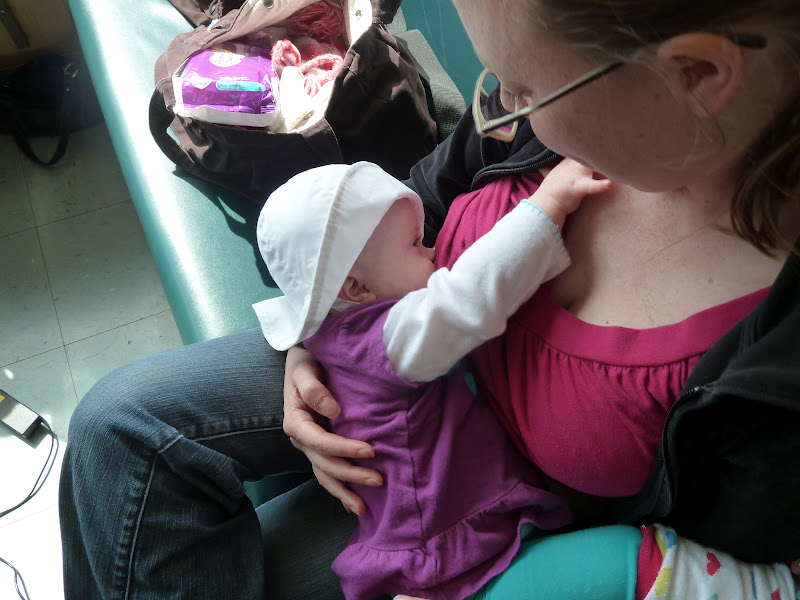
And the truth is, I love nursing. I don't feel that it's an invasion on my body at all. I love getting to snuggle Cora into me, legs tucked up in my arms, cuddled in. It's usually a combination of eating time and playing time; with my silly goose coming up for smiles, giggles and babbles, and periodic attempts to grab at my face or get her little fingers into my mouth.
And since it was such an enormous accomplishment for her to learn to nurse and to do so efficiently, I am in no hurry to give it up quickly. Factor in the great immune benefits it's seemed to offer her and her slow progress through solid food and I am even more pleased that she is such a good little nurser.
I read a blogging friend's post earlier this week about breastfeeding her daughter with Ds. Meriah from With a Little Moxie shared her story of the process of learning to breastfeed Moxie, despite the medical professionals doubts and despite the perseverance it required. Her post is a beautiful testament that often a mother does know best, even when the professionals disagree.
It was wonderful for me to read another positive breastfeeding story about a baby with Ds, since I know that these stories abound. Yet time and again, it seems that medical professionals are doubtful. And then the seed of doubt is planted, and maybe a new mother just stops trying, thinking that it's probably not worth the effort.
When we were desperately trying to get Cora out of the NICU she had to show that she could eat enough to go home. Breastfeeding wasn't happening all that easily, so a nurse that I liked told me that if I could get her to take x mL we could get her out of there. And that if I gave it to her in a bottle it would go faster, would be easier to her, and we could just work on breastfeeding later when we were home. Well, the volume that Cora had to take kept increasing and she just couldn't successfully keep up. So we chose a trial run of an NG feeding tube, thinking that a little help might be just what she needed to get over the hump and do it on her own. But she still couldn't keep up. So then we tried fortifying her expressed breast milk with formula (even though at first I couldn't conceive of being willing to do such a thing), so that she would need less volume to get the same calories, but still she couldn't keep up. Eventually we petitioned to take her home with an NG tube. The hospital didn't like that idea very much. We had to prove we could do it, go through training, rent equipment (that cost well over $1000 and that we never really used anyway), talk to case workers, and repeatedly convince the doctors on staff that we were competent. But, 18 days after going to the hospital with our little blue girl, we took her home with the tube. And a few days later she didn't need it anymore. Sure, after a few weeks, as her heart failure progressed significantly, she needed it back badly, unable to drink even an ounce out of her bottle.
During all this time, I attempted breastfeeding, a little every day. For weeks her heart-failure induced reflux was so bad she couldn't even try without gagging. But she'd cuddle against me and smell me.
When she started nursing less than two weeks after her surgery, I was amazed. And we've never looked back. She didn't need a nipple shield, we didn't need a whole bunch of lactation consultants looking over our shoulder (although I am sure that their earlier recommendations helped me a lot). We were off and running.
I am very proud to have been able to nurse her. But mostly I am proud of her. If you know me at all, you know that I think she's pretty amazing.
But the thing that I am not very happy about now, looking back, is all the advice I received. The NICU nurses, the lactation consultants, the occupational and physical therapists, the NICU doctors, the speech therapist and who knows who else had all told me that it would be more work for Cora to breastfeed than to bottle feed, especially with her heart defect. And because I wanted her to be able to successfully feed at all, I stopped trying so hard.
But the crazy thing that I have learned since then is that the American Heart Association states that "the "work" of breast-feeding is actually less than the work of bottle-feeding. Sucking, swallowing and breathing are easier for a baby to coordinate, and the amount of oxygen available to your baby is greater while breast-feeding than when bottle-feeding. In general, when compared to bottle-fed babies, breast-fed babies with congenital heart defects have more consistent weight gain."
What!? Excuse me??
Then why in the world were all those doctors and nurses telling me exactly the opposite?! It's maddening, is what it is.
Truthfully, Cora may not have done that well with breastfeeding initially anyway. She was in serious heart failure pretty early on, and did need a feeding tube and more calories than my breast milk alone provided. But still... I should have been provided accurate and up to date information. All parents should be. Especially those women out there with a Down syndrome diagnosis. The excellent benefits that breastfeeding a child with Down syndrome offers make it worth getting that information out there. And getting more of the success stories out there can only help that along.
 |
| Silly Goosie sneaking a mid-feed smile at Daddy. |
 |
| Cracking her mama up over here. Or is it the other way around? |
 |
| Sweet baby. |


